




A Visit to Bateman’s
July 2026
By Heather Cameron Hall
The historic home of Rudyard Kipling, author of The Jungle Book and other literary classics.
During my last visit to East Sussex, where I grew up, I had the pleasure of visiting Bateman’s, Rudyard Kipling’s former home. My dad, now retired, volunteers as a gardener there, and he introduced me to Victoria, the Senior Gardener. Victoria kindly invited me back for a personal tour of the gardens, giving me the opportunity to learn more about their history, meet the people who care for them, and share the experience with you all.
I had a wonderful afternoon. Victoria and fellow gardener Wizzy showed me around the grounds, sharing their knowledge, stories, and passion for this very special place. What began as a visit to a historic garden soon became something much more personal.
A Garden Inspired by Kipling’s Travels
As we wandered through the grounds, Victoria shared a detail that really stayed with me: many of the plants at Bateman’s came from Rudyard Kipling’s friends around the world, alongside others sourced from far-flung countries. In many ways, the garden reflects Kipling’s own life and travels.
Born in India to English parents, Kipling was sent to England as a child before returning to India as a young man. His experiences of different cultures and landscapes helped shape the writer he became, and that international influence can still be felt throughout the garden today. The planting and design embrace this connection, creating a living reflection of the world that influenced him.
The Kipling family moved to Bateman’s after the success of The Jungle Book which brought Rudyard considerable fame. They had previously lived in Rottingdean, but the attention and crowds eventually became too much. They wanted somewhere quieter, tucked away from the busy world.
The gardening team shared a lovely old story about the family’s arrival. When the Kiplings bought their motor car, the seller apparently dismissed these new machines as a passing novelty, joking that they would never really catch on. Had he realized just how remote Bateman’s was, he might have charged them more! Locals even nicknamed the approach to the house “the rabbit hole” because of the way the road disappears down into the countryside.
It’s easy to understand why the family fell in love with such a peaceful, secluded setting.
The Garden Closest to Home
One of the most interesting things I learned was that the garden immediately surrounding the house was Kipling’s own personal retreat, rather than the more formal gardens used for entertaining.
Standing there, I could imagine why. For a writer who spent so much time at his desk creating entire worlds through words, this quieter space must have offered a place to pause, think, and reconnect with the natural world. Even Victoria felt that this was likely to have been his own special corner of the garden.
Bateman’s was originally a farm, but the grounds were redesigned within weeks of the family moving in. The pear alley was created at the same time by the same designer, so the two spaces were always intended to complement one another.
Much of the garden's character may be rooted in Kipling's time, with many of the wall trained plants already growing here during his era. The wisteria, in particular, is a wonderful link to the gardens past, having survived as a living reminder of its history. While the garden may have evolved over the years, these established plants offer a tangible connection to the landscape as it would have once been known.
This year, the unusually hot weather encouraged a rare third flush of flowers. As beautiful as that must have been, I was told that nothing compares to the first flush in spring, when the wisteria is at its most spectacular and wonderfully fragrant.
After seeing the gardens during the UK heatwave, I would love to return in spring. The lawns were desperately in need of rain during my visit, and it would be wonderful to experience the grounds in a different season, when everything is fresh and flourishing.
Victoria also shared some exciting plans for this part of the garden, known as the Mulberry Project. It will be a multi-year undertaking, carefully carried out in stages to preserve the garden's character while keeping as much of the grounds accessible to visitors as possible. I’m looking forward to seeing how the project develops on my next visit.
Along the Border and Down to the Pond
The long border is a garden feature that deserves to be explored slowly, its Arts and Crafts- style planting reflecting the approach to gardening that the Kiplings were so drawn to.
Running alongside a neatly clipped yew hedge, with stone flagstones beneath your feet, it is filled with beautiful layers of colour and texture. White Hydrangea 'Annabelle' spills generously over the path, rusty-orange heleniums bring warmth, pale green sedum creates soft, cloud-like shapes, and tall purple agastache adds height and movement towards the back.
It is the sort of border that feels effortlessly beautiful, although you know it takes an enormous amount of care, patience, and experience to maintain.
Further along, the path opens onto the lily pond in front of the house, and the view is simply stunning.
The historic Jacobean façade, with its distinctive cluster of tall brick chimneys, is reflected in the still water. Water lilies float across the pond, while a wooden bench sits tucked into the surrounding hedge, inviting visitors to stop and take it all in.
It is one of those views that photographs beautifully but somehow feels even more special when you're standing there yourself.
Around the back of one of the outbuildings, I discovered a completely different garden detail: a beautiful red-and-grey Sussex brick gable wall, with fruit trees trained flat against it in graceful, spreading fans. It brought to mind the traditional kitchen gardens of another era, where every space was carefully considered and put to good use.
Roses the Colour of a Poem
One of my favourite discoveries was the story behind the roses.
Kipling once wrote a poem that referenced a blue rose, and the garden's designer chose to plant roses bred to come as close as possible to that elusive colour. I loved the thought behind this small but meaningful tribute — a literary reference brought to life through planting.
It is these thoughtful details that make Bateman’s so fascinating. The garden isn't simply a beautiful setting around a historic house; it tells stories about the people who lived there, the things they loved, and the influences that shaped their lives.
Nearby, the lime trees offer another glimpse into the site's earlier history. They were already growing there before Kipling arrived, planted by whoever farmed the land before the family made Bateman’s their home.
The People Who Keep It Growing
What surprised me most about the visit was how much I came away thinking about the people behind the garden, as well as the plants themselves.
The garden team is predominantly made up of women, with three of the four gardeners and both rangers being female. Alongside them is a dedicated group of volunteers who help care for the estate's 300 acres. Eight people work each day, come rain or shine, with Thursdays off.
Their work goes far beyond the pretty borders visitors see. There's constant weeding, shrub pruning, hedge cutting, mowing, and deadheading, all requiring time, skill, and patience. Apparently, even teaching a new volunteer how to deadhead properly can take a fair bit of explaining!
Victoria has a clear vision for the future of the gardens: to preserve their historic character and spirit while making sustainability an increasingly important part of their management.
Climate change and biodiversity are central considerations, not simply fashionable additions. Supporting pollinators is a priority, and this is reflected in the planting choices, with an emphasis on perennials rather than annuals. There is also an area dedicated to growing vegetables and cut flowers specifically for seed.
It is an approach I immediately connected with, as these are principles I have been gradually trying to incorporate into my own garden at home in Connecticut.
Len, who has managed the garden for fifteen years, has also played an important role in shaping the landscape I was exploring that afternoon. It takes years of dedication to create and maintain a garden with this much history, and it was lovely to hear about the people whose work continues that tradition.
Of course, gardening isn't always idyllic. In the middle of our conversations about conservation and historic planting, someone casually mentioned that badgers can be a real menace to the borders. Even a garden as special as Bateman’s has its challenges!
I took a photograph of Victoria and Wizzy standing on the brick path between the borders, with a towering stand of golden fennel flowering behind them. It rose higher than either of them, creating a beautiful backdrop.
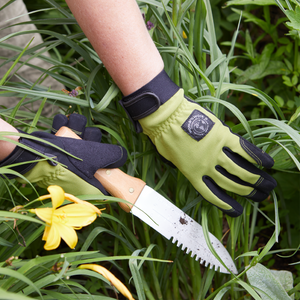
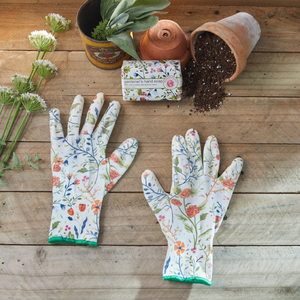
Looking at them, I was reminded of just how much physical work goes into caring for a garden of this scale. It's exactly the sort of work our gloves are designed for, and I was delighted to leave them a pair of our Weeder and Original work gloves to try.
Beyond them stood the old chimney stacks and a small cupola topped with a weathervane, all set beneath one of those heavy grey Sussex skies that seem perpetually undecided about whether to bring rain.
It was a lovely snapshot of the afternoon, capturing both the beauty of the gardens and the people who work so hard to maintain them.
Coming Back to Where It Began
There is something about historic gardens that stays with you long after you have left.
A house tells the story of how someone lived, but a garden tells the story of how they observed the world around them — season after season, through countless decisions, years of care, and the changing rhythms of nature.
At Bateman’s, that story continues today through the gardeners and volunteers who care for the grounds. Although they never knew Kipling himself, their dedication reflects a genuine affection for the place and a desire to preserve its character for future generations.
Walking among the roses and talking gardening with people in the county where I first learned to appreciate the natural world felt less like sightseeing and more like reconnecting with my own roots.
I left with a full heart, a head full of gardening inspiration, and plenty of ideas to think about back home in Connecticut. I may not be able to grow Bateman’s wisteria or its blue roses quite so easily in our colder winters, but I can take inspiration from the patience behind the planting.
Gardens take time. Sometimes a year, sometimes several. The best results often come from allowing things to develop naturally, making thoughtful changes along the way, and understanding that a garden is never truly finished.
It's a philosophy that resonates with the way we approach our own work gloves, too. We believe in making things that are built to be used, cared for, and relied upon for years, rather than replaced after a single season.
If you find yourself in East Sussex, I wholeheartedly recommend setting aside plenty of time to visit Bateman’s. And if you have the opportunity to chat with the gardeners, do take it. Their knowledge, stories, and enthusiasm bring the gardens to life in a way no guidebook ever could.
I know I'll be back — hopefully in spring, when the wisteria is in bloom and the garden is ready to tell me a few more stories.


